
Whole Blood Donation
From each whole blood donation, we prepare 3 to 4 transfusion products:
- red blood cell concentrate (erythrocytes),
- platelet concentrate (thrombocytes),
- plasma
- white blood cell concentrate (granulocytes).
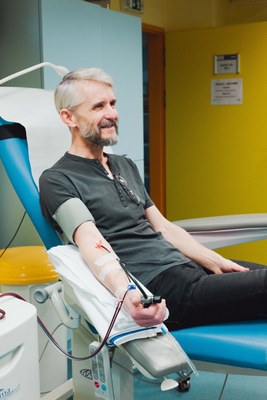
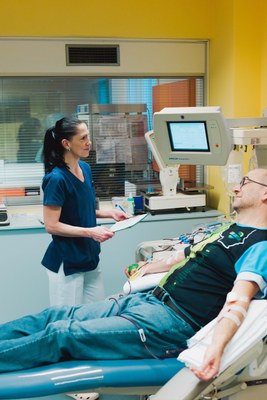 Red blood cells carry oxygen and carbon dioxide, are produced in the bone marrow, and live in circulation for 120 days. They are prepared for patients with a serious deficiency of red blood cells, which can occur as a result of bleeding, various diseases, or chemotherapy. The storage period for erythrocytes is 5–6 weeks.
Plasma is the liquid component of blood; it contains water, proteins, sugars, and minerals, and is replenished within 2–3 days. It is a source of substances needed to ensure blood clotting. It is prepared primarily for patients with serious blood clotting disorders, bleeding, and certain blood diseases where it cannot be replaced by other products. Plasma is stored in a frozen state for up to three years.
Platelets are blood components that participate in blood clotting, are formed in the bone marrow, and circulate in the bloodstream for only 7–10 days. They are prepared for patients with a serious platelet deficiency. The storage period for platelets is 5 days. One therapeutic dose requires platelets from 4 to 5 whole blood donations.
White blood cells (granulocytes) are blood components prepared for patients with a severe deficiency of white blood cells and difficult-to-manage infectious complications. The storage period for white blood cells is 24 hours. One therapeutic dose requires granulocytes from 6–8 whole blood donations.


-

MUDr. Jan Loužil, Ph.D.
Head of Transfusion Department
Phone: +420 221 977 625, +420 221 977 426, +420 221 977 318
Email: Jan.Louzil@uhkt.cz -
MUDr. Jana Hrušková
Deputy
Phone: +420 221 977 348, +420 221 977 460, +420 221 977 647
Email: Jana.Hruskova@uhkt.cz